As of July 2024, the median home price for the Nashville-Davidson-Murfreesboro-Franklin metropolitan area was around $447,000, a 2% increase from a year earlier.
According to one prominent forecast, the Nashville-area housing market could flatline over the next year, at least where home prices are concerned. Zillow predicted the median home price for this metro would decline by -0.5% from May 2024 to May 2025.
Granted, that’s a marginal decline in values. But the fact that they expect a drop of any size is noteworthy, when you consider how fast prices were rising just two years ago.
The graph below shows the median home value for the Nashville metro housing market going back to 2016. It’s based on data provided by Zillow.
You’ll notice three distinct trends in the above graph:
First, you can see where the COVID pandemic greatly accelerated home-price growth in the Nashville area, from 2020 – 2022.
You’ll also notice that prices peaked at an all-time record high toward the end of 2022, followed by a brief and shallow downturn.
Lastly, you can see how the median price has been mostly flat in recent months.
Recent forecasts for the Nashville-area housing market predict a continuation of trend #3 above. Analysts expect house values to hover within their current range through the remainder of 2024 and into 2025.
Whether it was a soaring stock market defying constant expectations of doom, a job marketrefusing to quit despite higher interest rates from the Fed or a housing market largely frozen in place due to steep mortgage rates, 2023 was full of surprises. In 2024, we’ll find out if the housing market can enjoy the same type of soft landing seemingly engineered by the Federal Reserve for the U.S. economy.
Just over a year ago, when I suggested to “expect a year of uncertainty mixed with the market slowly trending in favor of buyers,” that was mostly due to six ongoing trends in place at the time. These trends, including stubborn inflation (and higher mortgage rates), economic growth (or decline), the moving target of remote work, labor shortages, monetary tightening by central banks and turbulence in financial markets all came into play during the year.
Few professional economists and their armchair compatriots in homes and offices around the country would have predicted the most unexpected item of 2023: the Federal Reserve seemingly engineering a soft landing in its fight against inflation without causing a recession.
If anything, Fed Chair Jerome Powell was consistently derided for hiking rates too late and keeping them high for too long, leading in part to a semifrozen housing market with most potential sellers refusing to part with their unusually low mortgage rates.
In turn, the lowest inventory of existing homes for sale in decades helped propel a dramatic shift favoring new home builders and the incentives they could offer in the form of mortgage rate buydowns – against which most willing sellers of existing homes had little ammunition.
At the end of 2023, the stock market was certainly celebrating, and mortgage rates had fallen from recent highs on the assumption of several federal funds rate reductions throughout the year. The overhang of excess jobs versus the number of unemployed workers had fallen, fewer people were quitting in search of greener pastures (pun intended), and the unemployment rate remained under 4%. Celebrations were certainly in order.
However, Fed officials are cautioning that their work is not done yet and getting to the finish line of inflation closer to 2% per year may delay lower rates in 2024. Besides higher inflation potentially returning given a tight labor market for services, rising price tags for climate-related disasters, emerging geopolitical tensions around the world and numerous elections around the world – the most in recorded human history – this year will likely also provide its own unexpected events. The most likely potential domestic risks to the economy from these factors could include higher oil prices and backed-up supply chains.
For the housing market, lower mortgage rates are widely expected to lead to a surge in pent-up demand for not just new homes but for existing homes offered by sellers who need to move for a variety of reasons. Average fixed 30-year mortgage rates, which last peaked at 7.8% in late October, have since fallen by over 100 basis points, suggesting an early start to the homebuying season.
Homebuilders are certainly feeling more bullish, with the NAHB/Wells Fargo Housing Market Index rising three points to 37 in December, reversing a four-month decline. The six-month outlook is even better, rising six points to 45. Still, actually selling new homes in an environment of elevated mortgage rates is challenging, with 36% of builders reporting cutting home prices by an average of 6%. A much higher share of builders (60%) offered various sales incentives in December, matching November’s share but edging down from 62% in October.
The decline in mortgage rates also prompted more activity in housing starts, which surged in November to a six-month high of 1.56 million per year. With the rising popularity of build-to-rent homes, builders were more bullish on single-family units. These starts surged over 42% year-over-year to 1.14 million per year, the highest level since April 2022.
While multifamily developers did start nearly 9% more units in November versus October, the year-over-year decline of nearly 34% does point to abundant supply in multiple markets. The disconnect between single- and multifamily demand and supply will likely become more obvious in the months ahead, with rising vacancy rates, falling rents, more tenant incentives and higher cap rates indicating additional risk for apartment landlords. By Patrick S. Duffy
Move in applicable markets expected to cost industry group $1M annually: CEO Kelman
The sexual harassment scandal rocking the National Association of Realtors triggered a major residential player to pull its brokers brack.
Redfin is requiring its agents to cancel their membership in NAR where possible, according to an announcement. The move from the Seattle-based brokerage, first reported by the New York Times, says its expects its 1,800 members to immediately cancel memberships and stop paying dues to the organization.
That’s not going to be possible everywhere. In some markets, NAR’s control over the listing databases is so firmly entrenched that not being a member of the group would make it “impossible to be an agent,” Redfin said. In those markets, which include Houston, Las Vegas, Nashville and Phoenix, agents will likely remain due-paying NAR members to keep their access to the services.
“We’re asking NAR to decouple local access to these tools, including the listing databases known as Multiple Listing Services, from support for the national lobbying organization,” the announcement read.
The company’s withdrawal from NAR would cost the association about $1 million annually, CEO Glenn Kelman told the Times.
Redfin’s membership with the trade group started in 2017. Kelman said the brokerage quickly found issue with how NAR operated and it has spent months trying to extricate itself from the group before the sexual harassment scandal, including resigning its national board seat in June, before the allegations surfaced.
When the harassment issues came to light, that’s when it came to another level,” Kelman told the Times.
A spokesperson for NAR told the outlet the organization respected Redfin’s decision.
NAR president Kenny Parcell resigned after a New York Times reported accounts from multiple women accusing the leader of harassment and discrimination. He has denied the accusations. But the allegations around Parcell’s behavior are seated within a larger push for reform at the trade group, which accounts from former employees, a lawsuit and internal memo reported by the Times detail a toxic culture and retaliation against complaints by leadership.
Staffers at NAR have demanded the resignation of new president Tracy Kasper and top members of the organization, including CEO Bob Goldberg. The chief executive recently announced policy changes to address some of the concerns coming out of the scandal.
If you’re selling a residential or commercial property, getting a top-notch broker’s opinion of value can work in your favor. You’ll want to work with someone who is aware of what has sold in the past in the market, along with the current environment. It will be helpful if the broker has access to additional insight and data, which will make them stand out from others in the region, and ultimately increase your chances of a successful transaction.
1. Find Someone Who Uses the Right Sales Comps
2. Look for a Broker Who Knows Current Sales
3. Get a Broker Who Understands the Marketplace
4. Work with a Broker Who Has a Solid Track Record
After breaking into a market, each sale can help to establish a broker’s credibility. A long list of successful transactions and referrals will add relevance to an opinion of value. I offer to show others my entire sales list and let them contact any owner from it.
NAR identified 10 real estate markets that it expects to outperform other metro areas in 2023. In order, the markets are as follows:
Atlanta-Sandy Springs-Marietta, Georgia
Raleigh, North Carolina
Dallas-Fort Worth-Arlington, Texas
Fayetteville-Springdale-Rogers, Arkansas-Missouri
Greenville-Anderson-Mauldin, South Carolina
Charleston-North Charleston, South Carolina
Huntsville, Alabama
Jacksonville, Florida
San Antonio-New Braunfels, Texas
Knoxville, Tennessee
“The demand for housing continues to outpace supply,” Yun said. “The economic conditions in place in the top 10 U.S. markets, all of which are located in the South, provide the support for home prices to climb by at least 5% in 2023.”
NAR selected the top 10 real estate markets to watch in 2023 based on how they compared to the national average on the following economic indicators: 1) better housing affordability; 2) greater numbers of renters who can afford to buy a median-priced home; 3) stronger job growth; 4) faster growth of information industry jobs; 5) higher shares of the information industry in the respective local GDPs; 6) migration gains; 7) shares of workers teleworking; 8) faster population growth; 9) faster growth of active housing inventory; and 10) smaller housing shortages.
The National Association of Realtors® is America’s largest trade association, representing more than 1.5 million members involved in all aspects of the residential and commercial real estate industries.
Like many major cities across the country, the Nashville metro area real estate market has cooled considerably over the past six months. Once considered one of the hottest housing markets in the country, Nashville is now experiencing a major slowdown in home-buying activity, along with sustained inventory growth.
What does this mean for 2023?
Among other things, it means we could see something resembling a buyer’s market in Nashville in 2023. Local real estate conditions continue to shift in a more buyer-friendly direction, as we approach the end of 2022. And this will likely continue for the foreseeable future.
Inventory Growth in the Nashville Housing Market
Earlier this month, researchers from realtor.com published a housing market update with data for the nation’s 50 largest metro areas. According to that report, the Nashville-Davidson-Murfreesboro metropolitan area housing market had the third highest increase in property listings over the past year.
In October 2022, the total number of active property listings within the metro area increased by a whopping 145%. To put it differently, the total number of homes for sale in the Nashville real estate market more than doubled over the past 12 months.
To quote the November 2022 Realtor.com report:
“Among the 50 largest U.S. metros, 42 markets posted yearly active inventory gains in October, led by Phoenix(+173.9%), Raleigh, N.C. (+167.4%) and Nashville, Tenn. (+145.0%).”
Granted, supply levels are still relatively low from a historical standpoint. But there is clearly a shift taking place, as more and more homes come onto the market.
Inventory levels bottomed out at the end of 2021, following a COVID-fueled surge in home-buying activity. Nashville was one of the pandemic “boom towns” that experienced an influx of buyers from other parts of the country. As a result, supply levels plummeted and home prices rose like never before.
But now, higher prices and mortgage rates have slowed the real estate market in Nashville and across the nation. The short version is there are fewer buyers in the market who can actually afford to make a purchase these days. This has reduced demand and caused the local real estate market to decelerate.
If inventory growth continues into 2023, the market could shift in favor of buyers even more. In fact, we could see something resembling a buyer’s real estate market in the Nashville area within the next year or so.
According to the latest data from Zillow, the median home value in the Nashville area rose above $450,000 recently – and for the first time ever. When measured monthly, however, home prices across the metro area have actually dipped slightly over the past couple of months.
Some analysts expect to see a significant decline in home prices within the Nashville real estate market. According to an article by Fortune published earlier this week:
“Regionally, researchers acknowledge that shifts in home prices vary significantly by market. In bubbly markets like Boise and Nashville, Moody’s forecasts a decline of around 20%.”
That might be an overly bearish prediction. Due to the current supply-and-demand situation within the Nashville real estate market, we would be surprised to see home prices drop that far over the next couple of years. But a downturn of some degree seems likely at this point.
More importantly, falling prices tend to create a kind of snowball effect within a local real estate market.
When buyers get a sense that the market is depreciating, they tend to become wary of making a purchase. This reduces demand, which causes inventory to accumulate, which leads to further cooling in the real estate market. It’s a pattern we have seen many times in the past, and it usually follows a period of rapid growth like the one we’ve just exited.
It’s Taking Longer to Sell a Home These Days
In May of this year, homes listed for sale within the Nashville metro area spent a median of 17 days on the market. But as of last month, the median number of “days on market” had increased to 39 days. This means the real estate scene is slowing down, and it’s taking longer for sellers to find buyers.
All of these things are connected. Higher prices and mortgage rates have shrunk the pool of buyers, which leads to fewer and slower home sales. That’s the current state of the real estate market here, and in many other cities across the U.S.
The Nashville-area housing market has also experienced a sharp increase in the percentage of price reductions. A price reduction occurs when a homeowner initially lists a property at one price, but later lowers the price due to a lack of offers. An increase in these reductions provides further evidence that the real estate market is cooling.
A Nashville Buyer’s Market in 2023?
Real estate markets are driven by two major forces. Supply and demand. And the Nashville housing market has experienced a major shift on both sides of the equation.
On the supply side, more and more homes have been coming onto the market lately. This reduces the competition among buyers while putting more pressure on sellers.
On the demand side, higher housing costs, economic concerns, and other factors have caused some buyers to take a “wait-and-see approach.”
These and other trends could cause a significant and ongoing shift within the Nashville real estate market, as we move into 2023. Like many formerly red-hot housing scenes, this metro area might begin to resemble a buyer’s market in the near future.
Mortgage rates have changed dramatically since the start of the year.
The average rate for a 30-year fixed rate has doubled since sitting around 3% this time a year ago. High inflation is a major cause of rising rates, along with the Federal Reserve’s increases to its own interest rate to quell that high inflation.
High mortgage rates have turned the housing market upside down, with a previously hyper-competitive market now cooling significantly. While prices are falling in some areas, that may not make up for the increased costs homebuyers face in the form of significantly higher mortgage rates. Be sure to calculate your monthly payment – and give yourself wiggle room in your budget – to decide if a home is actually affordable to you.
Here are today’s average interest rates and what they mean for borrowers.
A handful of principal mortgage rates all increased today. The amazing growth in borrowing costs for fixed-rate 30-year mortgages is notable, but 15-year fixed rates also inched upward. We also saw an upswing in the average rate of 5/1 adjustable-rate mortgages (ARM).
Mortgage Rate Forecast: What Is Driving Mortgage Rate Change?
Inflation has been high this year, with the consumer price index at 8.3% year-over-year in August. That was down from July’s 8.5%, but still higher than expected, and it prompted the Federal Reserve to raise its key interest rate by 0.75 percentage points for the third time in a row this year.
Those factors have both pushed mortgage rates higher this year, from around 3.3% in January to more than 6% at the end of September.
“Inflation is absolutely in the driver’s seat, particularly as it pertains to mortgage rates. Until we get some sustained evidence that inflation is beginning to recede, the upward pressure on mortgage rates will remain,” says Odeta Kushi, deputy chief economist at First American Financial Corporation. By Jason Stauffer
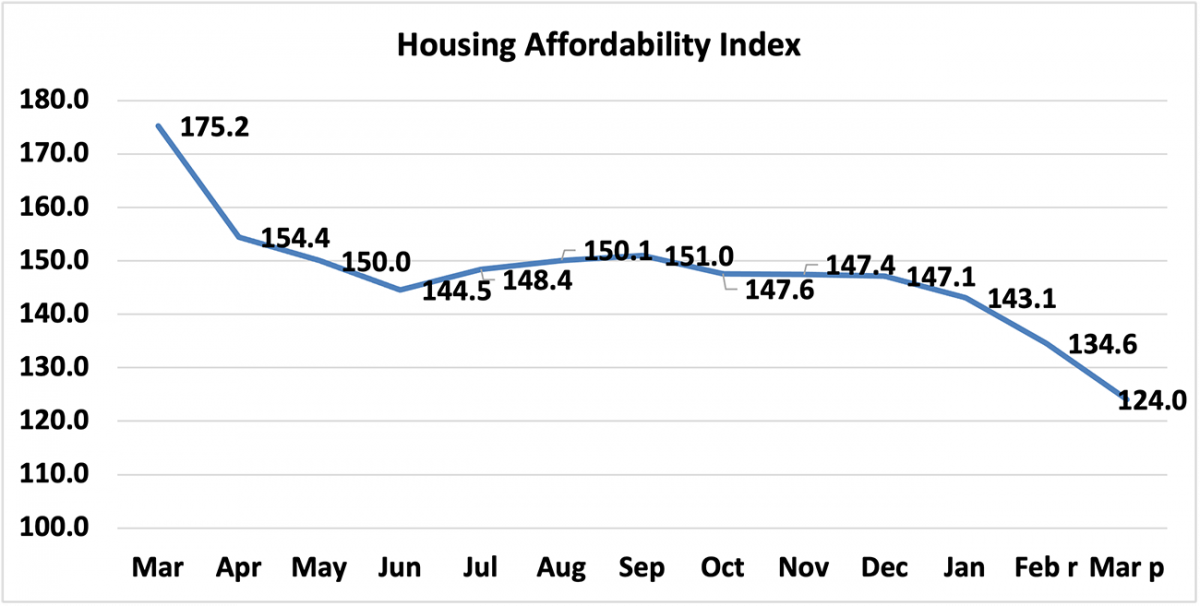
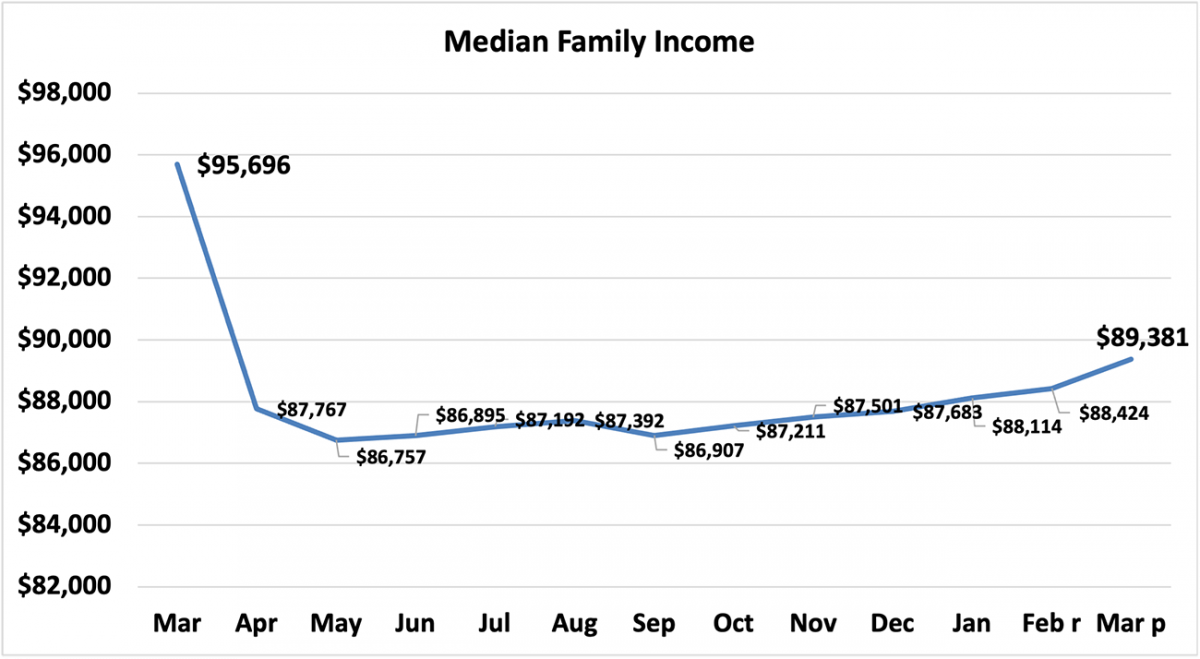
At the national level, housing affordability declined in March compared to the previous month according to NAR’s Housing Affordability Index. Compared to the prior month, the monthly mortgage payment increased by 9.7% while the median family income increased by 1.1%.
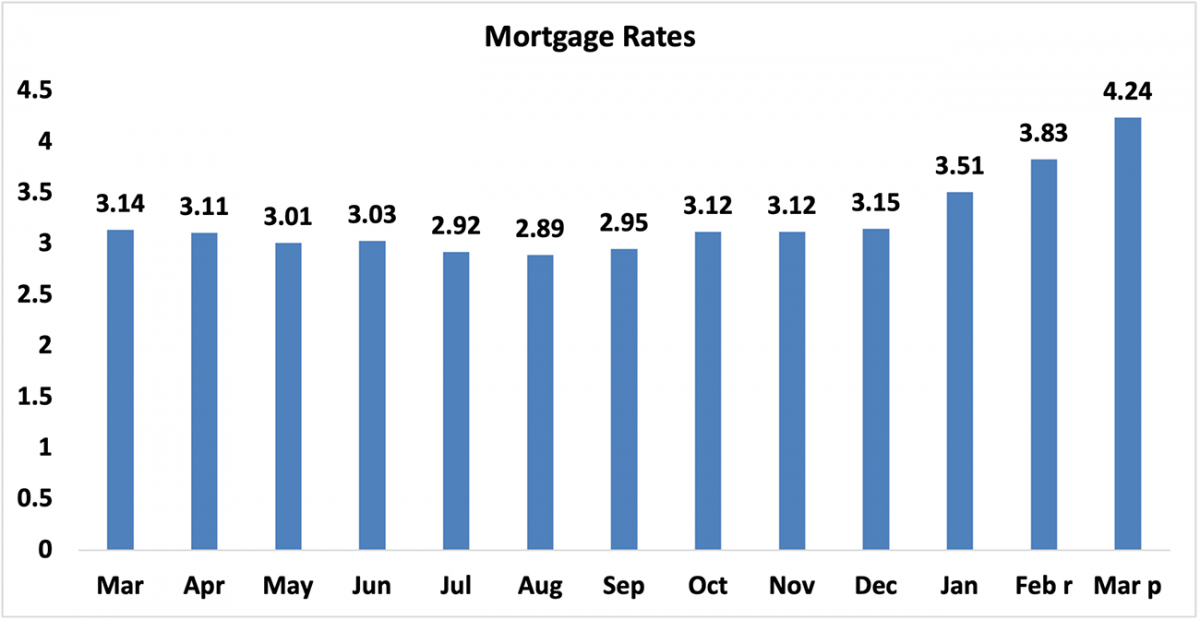
Compared to one year ago, affordability declined in March as the monthly mortgage payment climbed 32.0% and median family income fell by 6.6%. The effective 30-year fixed mortgage rate1was 4.24% this March compared to 3.14% one year ago, and the median existing-home sales price rose 15.2% from one year ago.
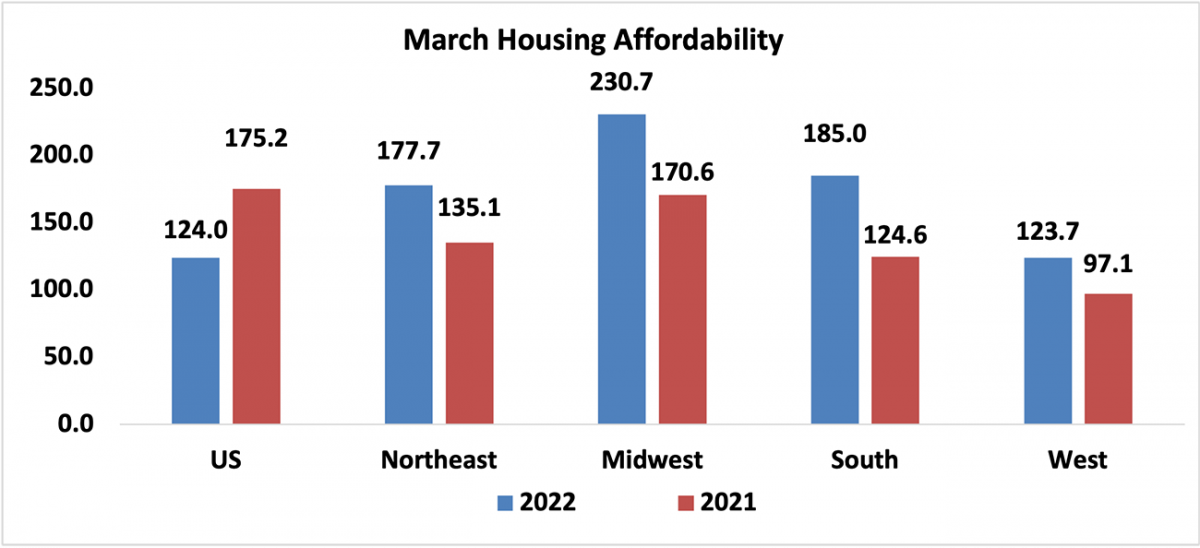
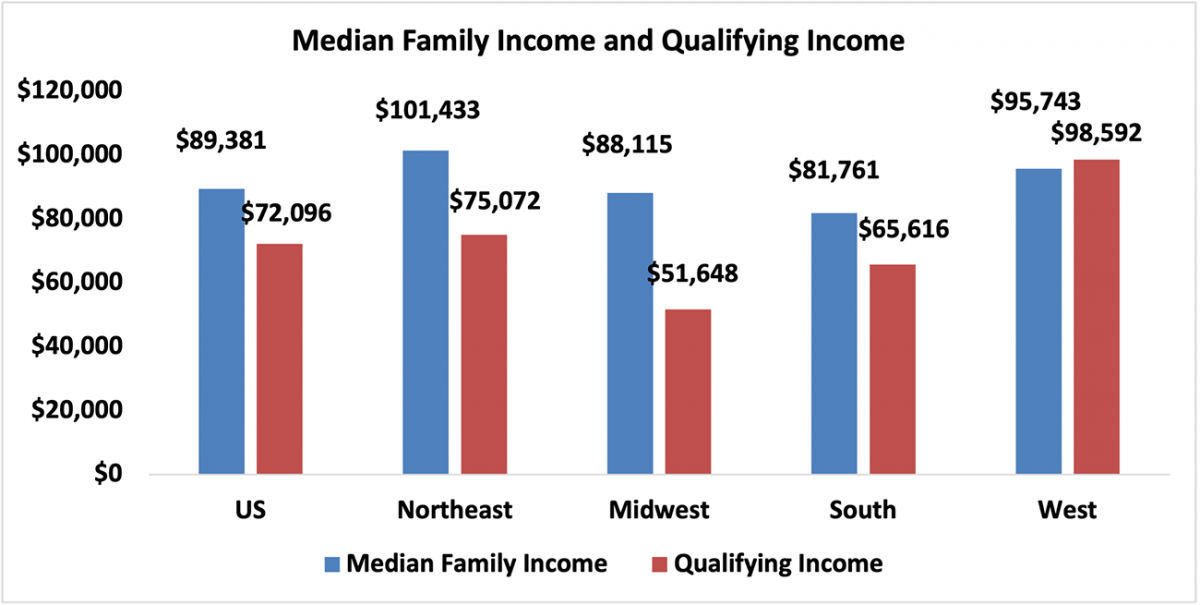
As of March 2022, the national and regional indices were all above 100, meaning that a family with the median income had more than the income required to afford a median-priced home. The income required to afford a mortgage, or the qualifying income, is the income needed so that mortgage payments on a 30-year fixed mortgage loan with a 20% down payment account for 25% of family income.2 The most affordable region was the Midwest, with an index value of 170.6 (median family income of $88,115 with a qualifying income of $51,648). The least affordable region remained the West, where the index was 97.1 (median family income of $95,743 and the qualifying income of $98,592). The index in the West has not been under 100 since July 2008. The South was the second most affordable region with an index of 124.6 (median family income of $81,761 and the qualifying income of $65,616). The Northeast was the second most unaffordable region with an index of 135.1 (median family income of $101,433 with a qualifying income of $75,072).
A home purchase was unaffordable for a typical first-time buyer intending to purchase a typical home. First-time buyers typically spent 25.6% of their family income on mortgage payments, making a home purchase unaffordable. A mortgage is affordable if the mortgage payment (principal and interest) amounts to 25% or less of the family’s income.3
Housing affordability4 had double-digit declines from a year ago in all four regions. The South had the biggest decline of 32.6%. The Midwest region experienced a weakening in price growth compared to a year ago of 26.1%. The Northeast fell 24.0% followed by the West which had the smallest dip of 21.5%.
Affordability was down in all regions from last month. The Midwest region fell 11.6% followed by the South with a decline of 8.0%. The Northeast was down 5.1% followed by the West which had the smallest decrease of 4.9%.
Nationally, mortgage rates were up 110 basis points from one year ago (one percentage point equals 100 basis points) from 3.14 to 4.24%.
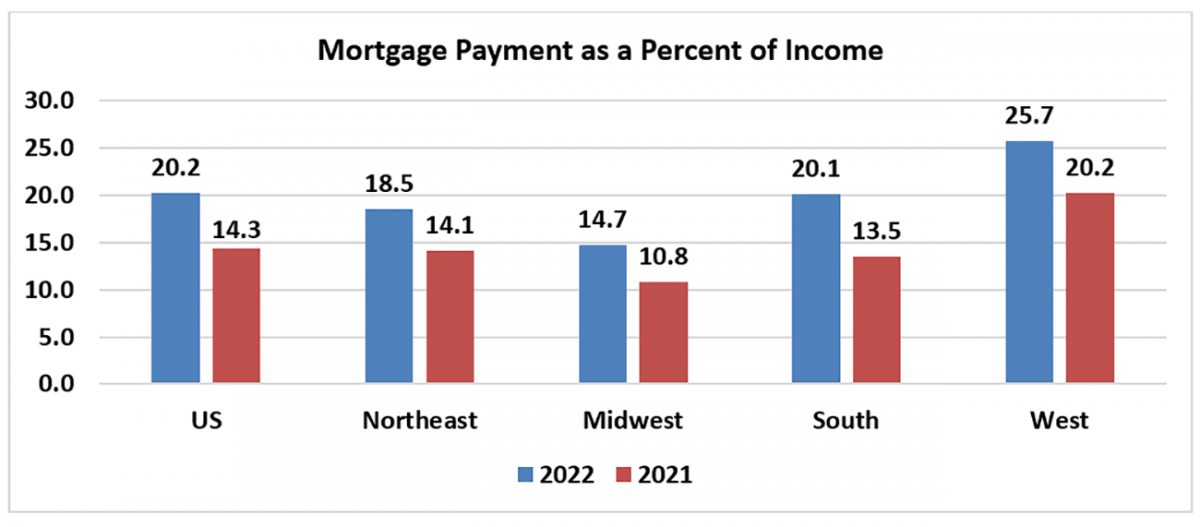
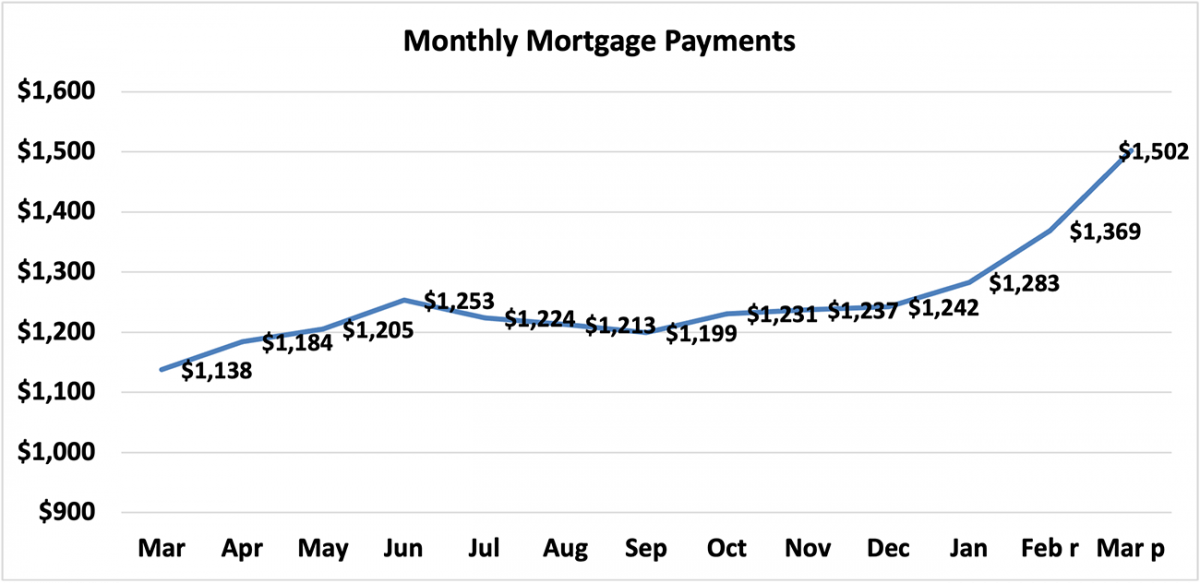
Compared to one year ago, the monthly mortgage payment rose to $1,502 from $1,138, an increase of 32%. The annual mortgage payment as a percentage of income increased to 20.2% this March from 14.3% a year ago due to higher home prices compared to declines in median family incomes. Regionally, the West has the highest mortgage payment to income share at 25.7% of income. The South had the second highest share at 20.1% followed by the Northeast with a share at 18.5%. The Midwest had the lowest mortgage payment as a percentage of income at 14.7%. Mortgage payments are not burdensome if they are no more than 25% of income.5
According to the Mortgage Bankers Association last week, mortgage applications increased 2.4% from one week earlier. The key factors of housing affordability are currently very challenging to overcome. Low inventory is carrying a substantial portion of that burden. Qualifying incomes have inclined, spikes in mortgage rates and incomes struggling behind home price gains are the main contributing factors for potential buyers to struggle to find a home.
The Housing Affordability Index calculation assumes a 20% down payment and a 25% qualifying ratio (principal and interest payment to income). See further details on the methodology and assumptions behind the calculation.
1 Starting in May 2019, FHFA discontinued the release of several mortgage rates and only published an adjustable rate mortgage called PMMS+ based on Freddie Mac Primary Mortgage Market Survey. With these changes, NAR discontinued the release of the HAI Composite Index (based on 30-year fixed rate and ARM) and starting in May 2019 only releases the HAI based on a 30-year mortgage. NAR calculates the 30-year effective fixed rate based on Freddie Mac’s 30-year fixed mortgage contract rate, 30-year fixed mortgage points and fees, and a median loan value based on the NAR median price and a 20% down payment.
2 Housing costs are burdensome if they take up more than 30% of income. The 25% share of mortgage payment to income takes into account that homeowners have additional expenses such as mortgage insurance, home insurance, taxes, and expenses for property maintenance.
3 A Home Affordability Index (HAI) value of 100 means that a family with the median income has exactly enough income to qualify for a mortgage on a median-priced home. An index of 120 signifies that a family earning the median income has 20% more than the level of income needed pay the mortgage on a median-priced home, assuming a 20% down payment so that the monthly payment and interest will not exceed 25% of this level of income (qualifying income).
Between inflation, supply chain woes and higher prices, it’s going to be a tough market for homebuyers.
The last 22 months have been some of the wildest in real estate history, as the COVID-19 pandemic accelerated the speed and intensity of recent trends. Home prices surged to record-breaking highs. Interest rates dropped to historic lows. And, amongst it all, the new era of online home buying and selling took further root. On top of that, just about every contemporary macro-economic trend — from inflation to supply chain woes to labor shortages — made an appearance in the 2021 housing market, increasing the advantages of existing homeowners, daunting prospective homebuyers and, ultimately, further widening wealth inequality in the US.
Though no one can predict what the next year will bring, we’ve asked some industry experts to help us read the tea leaves. Perhaps most significantly, home prices are expected to continue to rise, though at a slower rate than last year. As such, the 2022 housing market will present challenges for new buyers looking to get a foothold. For those looking to sell, new technologies like iBuying will continue to streamline and simplify real estate transactions. And existing homeowners will likely have another year to capitalize on rising property values through refinancing — if they haven’t already.
Experts also predict an extension of two major 2021 trends: low housing inventory and supply chain issues, both of which will continue to hamstring construction and renovations. Meanwhile, there are two new spectres on the scene: inflation and rising interest rates. “For a homebuyer, 2022 is going to require patience and strategy,” said Robert Dietz, chief economist the National Association of Home Builders.
“If you think you’re going to wait on the sidelines for the market to cool off, that usually doesn’t work,” cautions Karan Kaul, senior research associate at the Urban Institute. “Timing” the market is a tricky enterprise, and prices seem unlikely to decrease meaningfully any time soon.
With the caveat that political and virological developments can wreak havoc on this unpredictable corner of the economy, here are some of the major factors experts see influencing the housing market in 2022.
By : Alix Langone CNET
Buyers can expect tight competition for homes to continue into the new year.
You see these “Guaranteed Offers” marketed everyday in the real estate business. Another way these type of deals are marketed is “We Buy Houses”. There are several ways these programs work. The most important thing to know is that you will sign an agreement with terms. Just the same way you sign an agreement with your licensed listing agent, with terms and conditions.
Now typically if your house is one that has great functionality and is in a great location, and is correctly priced, it will sell. The only houses that may be a challenge to sell is the property that needs work, or is in an iffy location. But if priced correctly those homes sell to and just as fast. You see the picture ? PRICED CORRECTLY !
Now with price in mind, the guaranteed offer program works in many different ways. It all depends on what you sign and agree to. Some companies may purchase your property from you if it don’t sell. In order for the purchaser to profit, it will most certainly be sold to them under market value. You may also agree to a term in which if the property does not sell, the agent will sell it without compensation after the agreed period of time, or for less then the starting commission. You must read the fine print. You should never sign documents without fully understanding the terms and conditions.
When property owners see the ADVERTISMENTS for “NO SHOWINGS”, “NO OPEN HOUSES”. Well you must understand that most likely someone is going to view your home at some point. That is considered a showing. Even in a traditional sale you do not have to offer open houses, and you can control how many showings, and when you want the showings to occur. It’s all in what you agree to as the homeowner. Now your home may sell very quickly because of the price. Yes, under market value or fair market value. All those homes sell fast. You see the picture once again its all in the price.
Now if you are looking to make a profit on your investment, if you made renovations, worked hard making payments and have taken great care of your home, then I would recommend you hire a licensed Realtor who is looking to get you the “HIGHEST PRICE POINT” possible for your property. A professional looking out for your best interest, not the interest of their companies or for their own profitable interest. So understand that when you see “the guaranteed offer” or “we buy houses” just know there is a catch 22 to those deals.
Lakewood Realty will guarantee you that we will get you the highest price point possible for your home. We have proven results. Just look up our testimonials and reviews. We also will find you your dream home and negotiate every way possible for you to buy the property for what it’s worth ! No gimmicks, no ploys, just real results. Always remember, read all agreements very carefully prior to signing.







 Lakewood Realty Blog